

Adaptivity does not begin with “easier or harder”
Easier or harder is only one dimension. Why real adaptivity changes the kind of access a child gets, from micro-adaptivity to the hint ladder and the assistance dilemma.
Many learning platforms describe themselves as adaptive. What this usually means is a simple principle:
Children who solve several tasks correctly are given harder tasks. Children who make mistakes are given easier ones.
This logic is reasonable, but it is not enough to individualise mathematical learning in a meaningful way, because a wrong answer does not in itself tell you what should be easier next.
Difficulty has several dimensions
A task can be difficult for very different reasons: the number range is too large, the language is unnecessarily complicated, the representation is unfamiliar, a workable mental model is missing, or too much information has to be processed at once.
Two tasks that are answered incorrectly with the same statistical frequency can therefore make completely different demands.
Two children with the same result do not necessarily need the same next task either.
Child A understands the mathematical concept but calculates with little confidence. Child B has mastered the procedure but cannot connect it to a representation. Child C has misunderstood the wording of the task.
Moving all three down to an “easier level” would not be genuine adaptivity; it would be no more than sorting by success rate.
Two levels: macro-adaptivity and micro-adaptivity
Mazio Math distinguishes between two levels of adaptation.
Macro-adaptivity concerns the longer-term learning path: which content follows on from which? Which competence should be revisited? Which task family fits the current level of learning?
At Mazio Math, this level is not hidden inside the system. Teachers see in the analyses on their dashboard where their class stands, and steer the longer-term learning path themselves on that basis.

Micro-adaptivity concerns the specific moment within a task: which response helps after this particular input?
In primary school in particular, the second level is often the more decisive one.
A child frequently needs neither a different topic nor a new difficulty level, but a different way into the same problem.
Mazio Math therefore allows for a range of adaptive responses:
- Reduce complexity: smaller numbers or fewer simultaneous steps,
- Switch representation: from symbols to materials, images, a number line or an action,
- Isolate a sub-problem: work on the critical step only,
- Create contrast: compare two similar cases,
- Activate a strategy: recall a familiar decomposition or relationship,
- Delay feedback: allow a second independent attempt,
- Increase support: move from an open prompt to a more concrete hint.
This does more than make the task easier or harder; it changes the nature of the access.
An example: a different representation instead of smaller numbers
Suppose a child answers the task 42 − 17 incorrectly.
A conventional adaptive platform might then offer 32 − 11. The numbers are smaller. The underlying problem may well remain unchanged.
If the child does not understand why a ten is decomposed when crossing the tens boundary, a smaller symbolic task is not necessarily helpful.
A more useful response might be to represent 42 as four tens and two ones. The child converts one ten into ten ones and then carries out the subtraction within that representation.
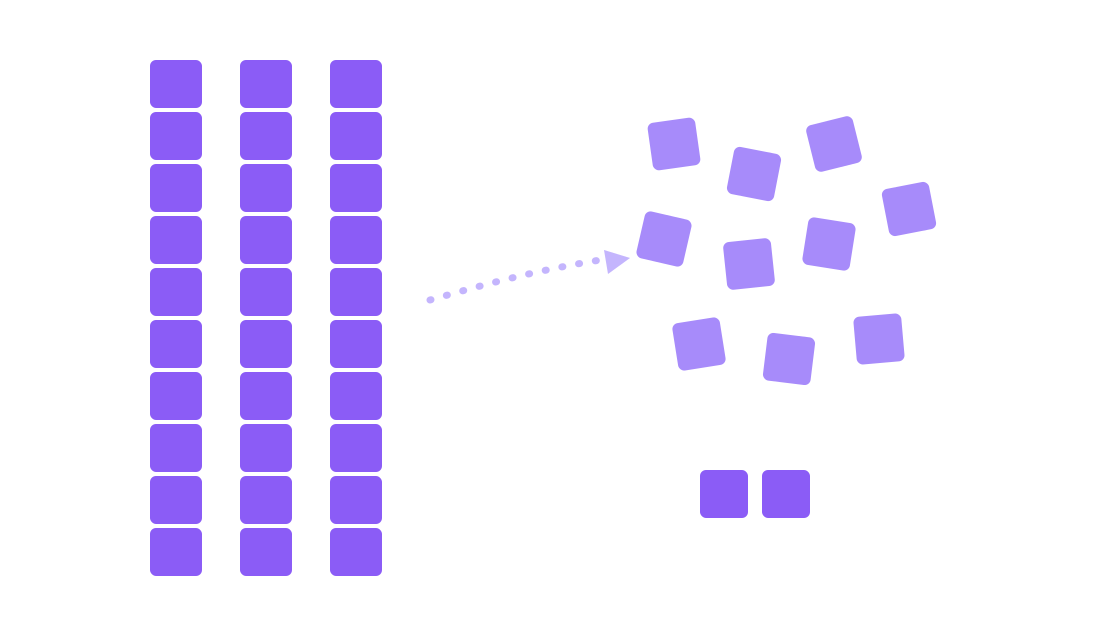
The mathematical demand remains in place; it is only made accessible. This marks an important difference:
Good adaptivity does not automatically reduce the mathematics. It changes the support so that the child can keep working on the mathematics.
The assistance dilemma
Tutoring systems face a fundamental problem: how much help is useful?
Too little help can lead to frustration and unproductive stalling. Too much help can take over the thinking itself.
Research on intelligent tutoring systems calls this the “assistance dilemma”. The use of hints is not automatically positive either. Help can support learning when it is used deliberately at a demanding step. Clicking quickly through hints, by contrast, can be associated with weaker learning.
For Mazio, this means that a good hint has to be more than factually correct; it also has to appear at the right time and at the right level.
Mazio Math therefore works with a hint ladder:
- direct attention to the relevant aspect,
- ask a question about the approach taken so far,
- offer a suitable representation,
- activate a familiar strategy,
- finally, make the next sub-step small enough for the child to take it alone.
Mazio never supplies a complete solution. Even at the highest level, the last step stays with the child, who solves the task independently in the end.
The aim is not to reach the right answer as quickly as possible, but to restore independent thinking with as little support as possible.
Learner model and task model
Many systems talk about a learner model: they estimate which competences a child has mastered and which it has not.
That is useful, but incomplete.
A precise task model matters just as much:
- Which sub-competences are required?
- Which representations occur?
- Which steps are possible?
- Which parameters determine the difficulty?
- Which errors can be interpreted mathematically?
- Which forms of help suit which step?
- Which answers are correct but unexpected?
Without this task model, a system can identify statistical patterns, but it does not understand well enough what it should be responding to.
At Mazio Math, adaptivity is therefore built into the structure of the task families rather than separated from the content as an overarching algorithm. This takes more work, but it is more controllable and mathematically more precise.
AI within fixed subject rules
Large language models can formulate flexible explanations and process open input. They can also produce answers that are plausible but wrong or pedagogically unsuitable.
Not every adaptive decision is therefore delegated to a language model.
In Mazio Math, fixed subject rules define the space of permissible responses. The AI works within that space:
- It can adjust the wording of an explanation.
- It can match an open answer to a known solution path.
- It can formulate follow-up questions.
- It can choose between several pedagogically approved hints.
It does not, however, decide spontaneously which mathematical concept is taught next when there is no controlled basis for doing so.
The AI thus extends the flexibility of the system; its reliability comes from the pedagogical model.
Support is withdrawn again
A system that adapts to the maximum at all times sounds ideal at first. But learning also means becoming increasingly able to act without support. Good adaptivity therefore withdraws its help again.
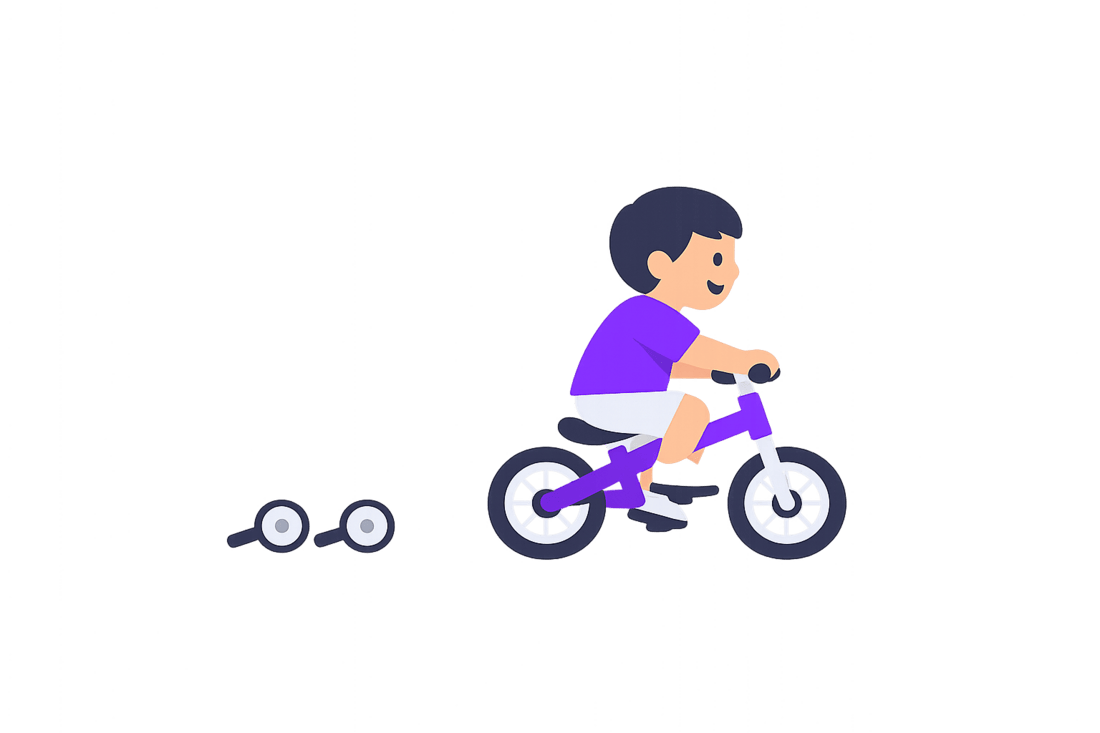
A representation is offered at first and removed later. A hint is not shown automatically on the next similar task. A sub-step is supported at first and then handed back to the child.
The aim is not for the system to adapt ever more precisely to the child's dependence, but for the child to need the system less and less.
Meta-analyses show that intelligent tutoring systems can improve learning outcomes. They do not show that every form of personalisation is effective. The effect depends on the specific design, the content and how it is embedded.
For Mazio Math, adaptivity is therefore not a single feature but the ability to enable a mathematically justified next learning action after a specific action, and to withdraw the support step by step.